

By Ben Christensen, The Old Republic Journal
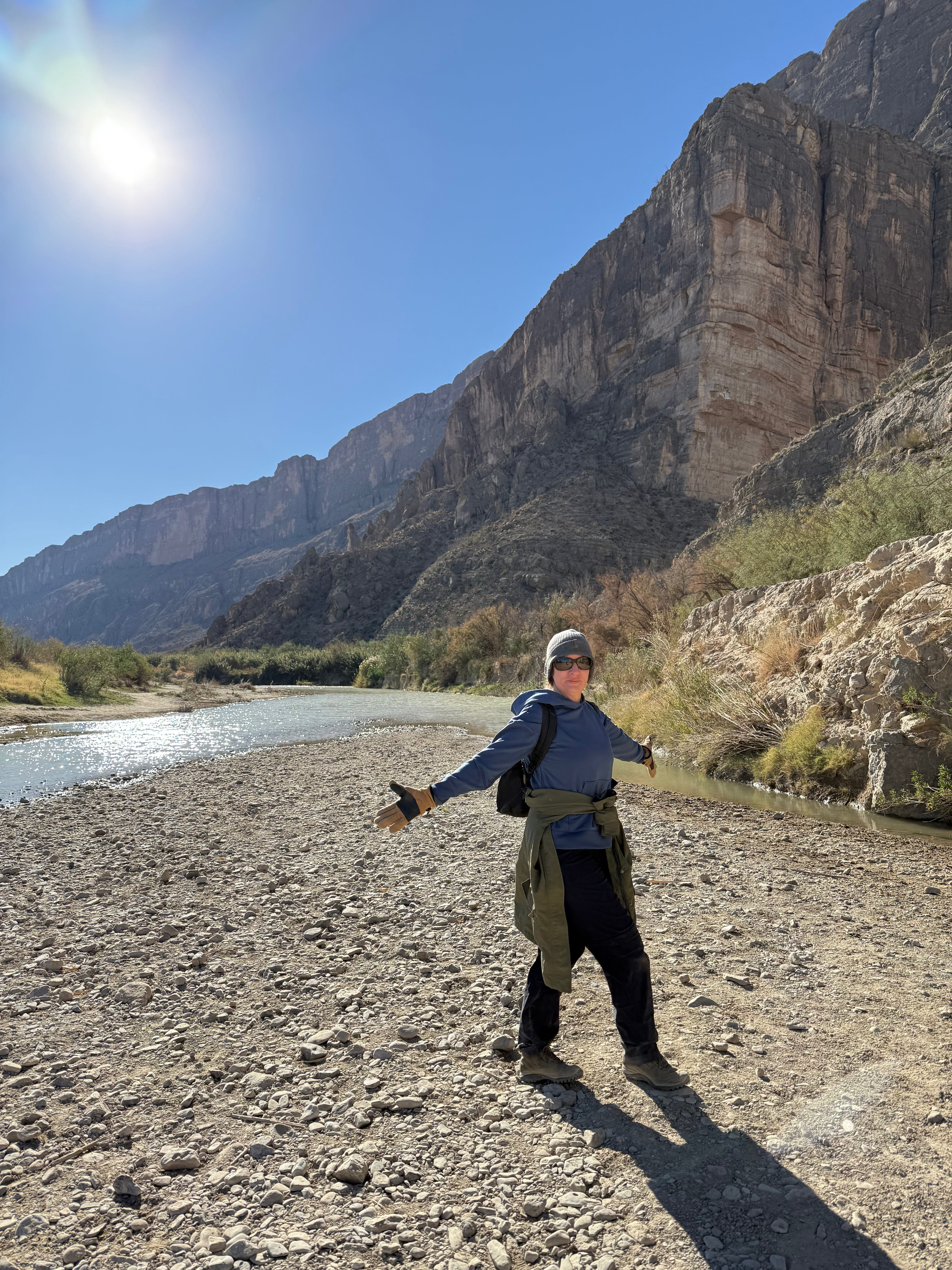
Hiking into the mouth of Santa Elena Canyon at Big Bend National Park this past January, I basked in a warm sun and watched the Rio Grande course muddily down toward Lake Amistad. I was struck by how happy my wife and our children were.
Lynette kept saying “Oooh, this is so beautiful!” in a giddy tone of voice as we crunched along the trail to the riverbank. The towering bluffs above us on the Mexican side, and to our north on the Texan side, were a sight to behold.
“Is that Mexico right there?” some of the younger children kept asking, incredulous that they could throw a rock into another country.
“Yes,” I was happy to reply.
I was struck by a border that didn’t need guarding. That didn’t need a bollard wall, because it was so remote that the country itself did the work.
On August 5, federal contractors hauled heavy equipment into that same stretch of park and began clearing the riparian brush at the foot of the canyon. The project is called Big Bend 4—a $1.72 billion contract, awarded in May to an Albuquerque subsidiary of energy-sector construction contractors Kiewit Corporation. About 17 miles of vehicle barrier and something on the order of 205 miles of patrol road are supposed to be cut through the wildest country left in Texas. In June, the Department of Homeland Security waived 28 environmental laws to clear the way. Pink survey ribbon now runs where willow and mesquite stood in January.
The Big Bend sector accounted for about 1.3 percent of border apprehensions in 2025. Inside the national park itself, the figure was 0.045 percent — four hundredths of one percent.
I am from the Rio Grande delta, on the Texas-Mexico border. I take the contract, the bulldozing—all of it—as a personal affront. I feel it viscerally. My wife Lynette is outraged, and chances are, you are outraged. This is a crime, but it’s yet another example of a long history of environmental degradation in American history.
My Grandma Rosa died when I was a sophomore in high school, a day before her ninetieth birthday, in a trundle bed on the floor of the ranch house she had had built by braceros in the early 1950s.
Rosa Eubank Christensen was from another era. She was my dad’s mother, born in 1902 on a ranch near the railway stop and post office at Antelope Gap, Texas — about halfway between Lometa and Goldthwaite, a little closer to Lometa, not far east of where Highway 183 runs northwest to southeast to connect the two hamlets.
Grandma Rosa reminisced about more things than I can list here, but interspersed with the bandits and the hurricanes and the cattle was always the beauty of the country.
“I am from the Hill Country,” she’d say proudly. “We had hills and cricks and rivers. It was beautiful.”
She was twelve when the family left Goldthwaite in 1914 for a farm in the Rio Grande delta just west of Brownsville. She had been diagnosed with tuberculosis, and the family doctor told them a hot, humid climate would improve her chances. Her father and mother sold their share of the ranch, packed their belongings onto the train, and rode south through Austin all the way to the station on the Texas-Mexico border.
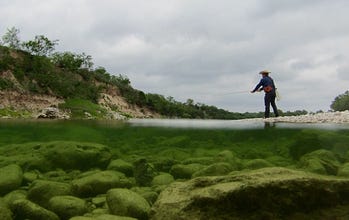
They called it the Magic Valley then. The Texas Rio Grande Valley is not a valley at all — that was a marketing scheme. It is a hot, humid, table-flat clay and loam delta of astonishing natural beauty and an ecosystem that has been coming apart from upriver dams and road construction for more than a hundred years.
“Before the Army cleared most of it, the willow breaks on both sides of the river were a mile wide,” she’d say. “It was incredibly beautiful down in the willow breaks. It was like a jungle.”
She meant the stands of native black willow along the river bends near Bluetown, where the farm was, grown up thick like a jungle that she and her brother played in. In August 1915, as the Border War between Mexican insurgents and General Carranza’s regulars flared onto the Texan side of the river, the Army troops deployed along the border began clearing my grandmother’s willow jungle.
That was a hundred and eleven years ago, and the willow breaks were cleared in the name of border security. They were soldiers with orders, in a place where people were there was an active military insurgency on American soil. My grandmother said her farmhouse was used as a rally point by “bandits” on horseback from Mexico after they had crossed the river on nights lit by the full moon. In college, I lined up the night-time attacks by Mexican insurgents on Army outposts and the Norias Division of the King Ranch with the U.S. Naval Observatory astronomical data, and lo and behold, they were conducted during full moon nights. The insurgents never attacked my grandmother’s farmhouse, just riding silently into the night after assembling, my grandmother said.
Drive US 281 west of Brownsville today — from the Tractor Supply in south Brownsville that doesn’t stock the mower blade you need to the Tractor Supply in San Benito that does (like I did a couple of weeks ago), taking the longer border way to show your children the land — and you can still see a few native stands of black willow. Only a few. You can also see miles and miles of 20-foot-tall steel bollard wall running somewhere through my grandmother’s old farm, where the Eubank family kept the dairy that supplied San Benito with much of its fresh milk.
The ranch where I was raised and the house I grew up in were Grandma Rosa’s projects, built through the late 1940s and 1950s after she had been widowed by a murderer. She was still growing that place the way a suburbanite puzzles over the morning Wordle — block by block, right up until her death.
The circle driveway on the west side of the ranch house had dark mafic Packsaddle Schist rocks the size of big watermelons, set in a circle—a ranch cul-de-sac. Her brother B.G. hauled them down from the Goldthwaite country as a present, to remind her of where they were children. She kept a piece of the Hill Country in her driveway for sixty years.
Five wind turbines now stand on that ranch, 287 feet from base to nacelle, part of a field of dozens at the San Roman Wind Farm west of Laguna Vista. My parents made that decision as stewards of the two and a half sections Grandma Rosa assembled over four decades. I don’t have a financial dog in that fight anymore. The turbines were well-intentioned. They were the responsible, forward-looking choice. My parents had wanted to leave the income source to their kids and grandkids. For my dad, there was the added bonus of keeping local towns and municipalities from annexing his property.
But when those enormous, bird-killing contraptions of so-called “green energy” reach the end of their service life in 30 years, the blades — fiberglass composite, non-biodegradable, over 100 feet long get buried in the plains somewhere above the dwindling Ogalalla Aquifer. Meanwhile, out in the Eagle Ford and the Permian, those flares you see burning off the horizon are natural gas — clean-burning, low-emission, genuinely valuable fuel — set on fire because in the rush to drill we never built the infrastructure to carry it to a power plant or a home.
I don’t think this is at its core a political argument. I don’t like it when people frame this as a one-side-versus-the-other political fight. It’s not.
The medieval scholastics, led by the colossal human mind of Thomas Aquinas, formulated the philosophy of natural law. This was at its core a philosophy of happiness, that begins with considering what was good for humans, and what led to human happiness. It was the order of God’s universe, according to Aquinas, that was good for humans and fosters our happiness. Aquinas taught a synthesis of classical Greek thought, chiefly Aristotle, the Christian Bible, and reconciled them with the teachings of the Christian church.
The land, according to Aquinas, could be owned. But degrading it and despoiling it the way we have in the past 400 years, since the “Enlightenment” rejected the philosophy of natural law and enabled industrialization and the commodification of God’s dominion, is immoral.
The opposition at Big Bend is of course bipartisan. That’s the good news. People do care, at the end of the day, about America the Beautiful. I mean, we’re Texans, right? And these are feds? Render a letter to Caesar and Pilate. Tell them what we think about wind farms along the Devil’s River and bulldozers in Santa Elena Canyon. At some point, we have to act. I have written many letters to Senators Cornyn and Cruz, and emails to U.S. Congressman Chip Roy about environmental issues. If you don’t know who your representatives are, start here.
We should not stop at Big Bend. Big Bend is visceral because it is beautiful to all of us, and because bulldozers at the mouth of Santa Elena Canyon are what they call in Austin and Washington bad optics. But the willow breaks near Bluetown were beautiful too, and precious few people outside my family ever knew they were there in the first place.
The Old Republic Journal is for an ethos of America the Beautiful. It is for public land held in common, and it is for a morality that re-constitutes the whole person living in a whole landscape. That requires genuine stewardship.
My great-uncle hauled a truck-full of rocks from the Hill Country to the extreme southern tip of Texas so his little sister could look at them and remember their early youth spent among the hills and creeks and junipers. They were dark brown and not really much to look at, the same as the ones in front of the convenience store catty-corner from the town square in Goldthwaite. But they were a physical sign of her heritage, and, at the very least, so is the land we love.
We’ll see y’all out there. — Ben
Great writing, Ben