
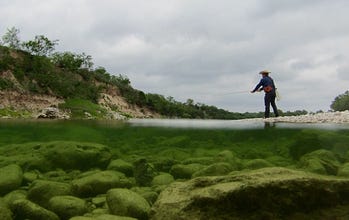
Nilgai Hunting on Old Republic Ranch
Shopping for groceries with the .300 Winchester Magnum

By Ben Christensen, Old Republic Journal
The brush still smelled like rain, and the plants had awakened with scents of spice, and the earth smelled of fertility. The remnants of Tropical Storm Bertha had blown ashore Thursday morning with a burst of rain and wind while I was trying to fish the baitfish migration miles north of the town of South Padre Island, leaving Friday’s dawn weather unseasonably cool. The large orange sphere of the sun hung a few degrees off my left shoulder, not high above the low green canopy of scrub brush.
As I walked south around a low mesquite, I had the wind on the left side of my face, blowing gently south by southeast. Around the other side of the cascading veil of green mesquite, not 10 yards in front of me were two nilgai, tan coats lit red by the morning sun, with tell-tale black manes and white patches on their faces, a female and a large weaning calf on a game trail quartering to my right. The larger lead cow was obscured from shooting by a veil of green and woody thorn plants, but the calf was quartered towards me. Busted! Exactly the situation I try to avoid when I am out hunting on foot, like I do when I am provisioning meat for my family.
Busted. I expected the thing that usually happens in a scenario like this: cows start that dogged trot along the trail, picking up speed as they head for some far horizon, asses low, pushing a lope while front legs high-step from a gallop to a dead run.
Only the big blue bulls are stupid and macho enough to stand there long enough for you to shoot. I once filmed a client who aimed at a bull from 40 yards with his rifle resting on a tripod for a full 96 seconds while I urged him to take the shot and gave him every kind of encouragement while the bull stood broadside to us before it decided things were too weird and finally ran off. The client never took the shot. “I’ll get the next one,” he said confidently, and you know how that went for him.
I knew if I got three seconds to set up a shot I’d be lucky. I dropped the tripod I was carrying in my left hand that nilgai hunters use to prop heavy-caliber rifles, with bull barrels and enormous rifle scopes for long-distance shots. I had my Remington .300 Winchester Magnum slung over my right shoulder. Luckily, I had dialed the scope all the way back to 4X magnification, so I wasn’t looking at a tick on a patch of fur if I got a suboptimal close-up shot just like this one. At that moment I hated having to use a scoped rifle for a safari-style hunt on foot through the Texas veldt. I had already vowed to buy a Winchester Model 70 Safari in .375 H&H Magnum with iron sights if I ever got the bread for it. That would have been the perfect rifle for this scenario.
The calf looked intently at me from about eight yards, quartering only slightly to my right, its bright eyes processing me, just starting to tense with alarm. I brought the heavy rifle to my shoulder, acquired a sight picture through the scope of his fuzzy brisket, made no conscious adjustments to windage or elevation, and sent a shot home before any of us had had more than about a second-and-a-half to think. The round found its mark and the young animal—a bull with two nubs on his head—shuddered and collapsed, kicking out as his vitality left him on the game trail where he had fallen. In about eight seconds, the scene returned to stillness. After gauging his weight by pulling on his hind legs, I decided I’d go get the tractor.
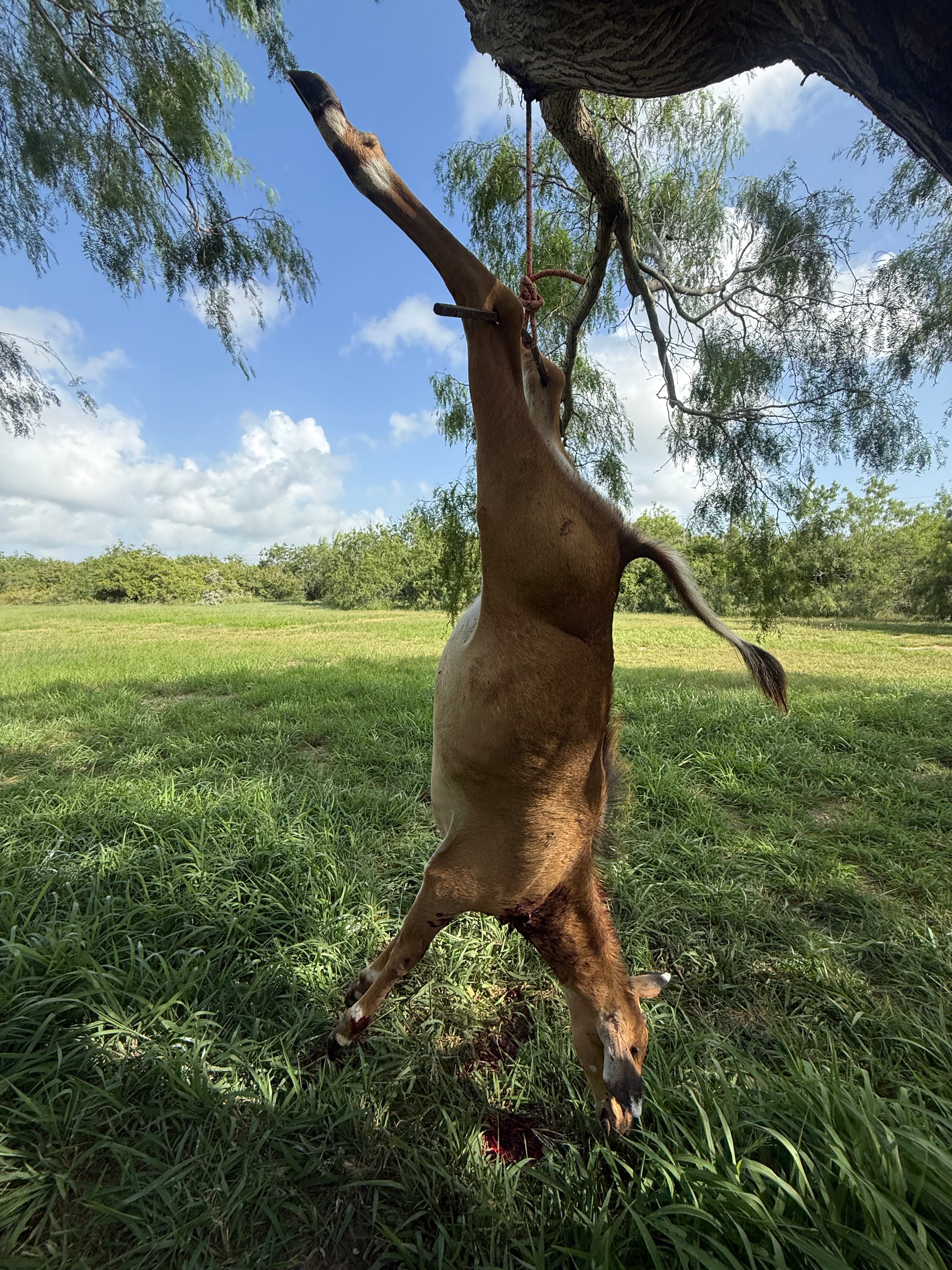
Nilgai bull calf, ready for field dressing. Photo by Ben Christensen
I try to hunt with the sun at my back and the wind in my face. When I am guiding clients, statistics and a high pressure to get our shot typically demand a good sit in a box blind overlooking a game trail, as we don’t bait nilgai. When I am hunting for meat, I will often sit a while, but I prefer to stalk along the senderos I have bulldozed on the place over the years, laid this way and that to account for various arrangements of wind and sun.
If I spot quarry without busting it and sending it running for the horizon, and I can’t kill it at that same instant, I work out a plan to kill it based entirely on wind direction and the position of the sun in its diurnal arc. That’s exactly what I had done with these two animals Friday morning. I had seen them at 100 yards to the east down my longest east-west sendero. I saw them cross the sendero heading north as I walked east, but with neighbors to consider and a round that likes to travel, I planned my stalk. I cut north to my main north-south sendero on a path to intercept the pair.
I set up my tripod and rifle overlooking the main north-south sendero and stood for 40 minutes waiting for them to show. When they didn’t, I realized they were grazing along browse lines in the brush to my east, so I walked east into the brush, knowing if I spotted them I’d have to be quick on the draw. We had run out of nilgai meat about six weeks ago, and my wife had ordered more, and it’s my job to deliver the groceries however I am able. I knew she would be thrilled to receive a tender young nilgai bull calf with the body size of a full-grown Michigan white-tail buck.
I grew up on the cattle ranch that took up two-and-a-half sections of hard and thorny coastal South Texas land. The way things shook out, I inherited the old horse pasture, which is the prettiest and most accessible piece of the whole thing. It sustained our remuda of horses before it was used for anything else. I grew up dodging rattlesnake strikes out there and watering the horses with a green garden hose in an old enamel bathtub when I was a boy. The bunkhouse I built on the place is 10 miles from South Padre Island. Friday afternoon, after I had field dressed and split the carcass and deposited it in the chest-freezer I use for chilling harvested meat, I watched Elon Musk send another rocket into space from the second-story roof of the bunkhouse.
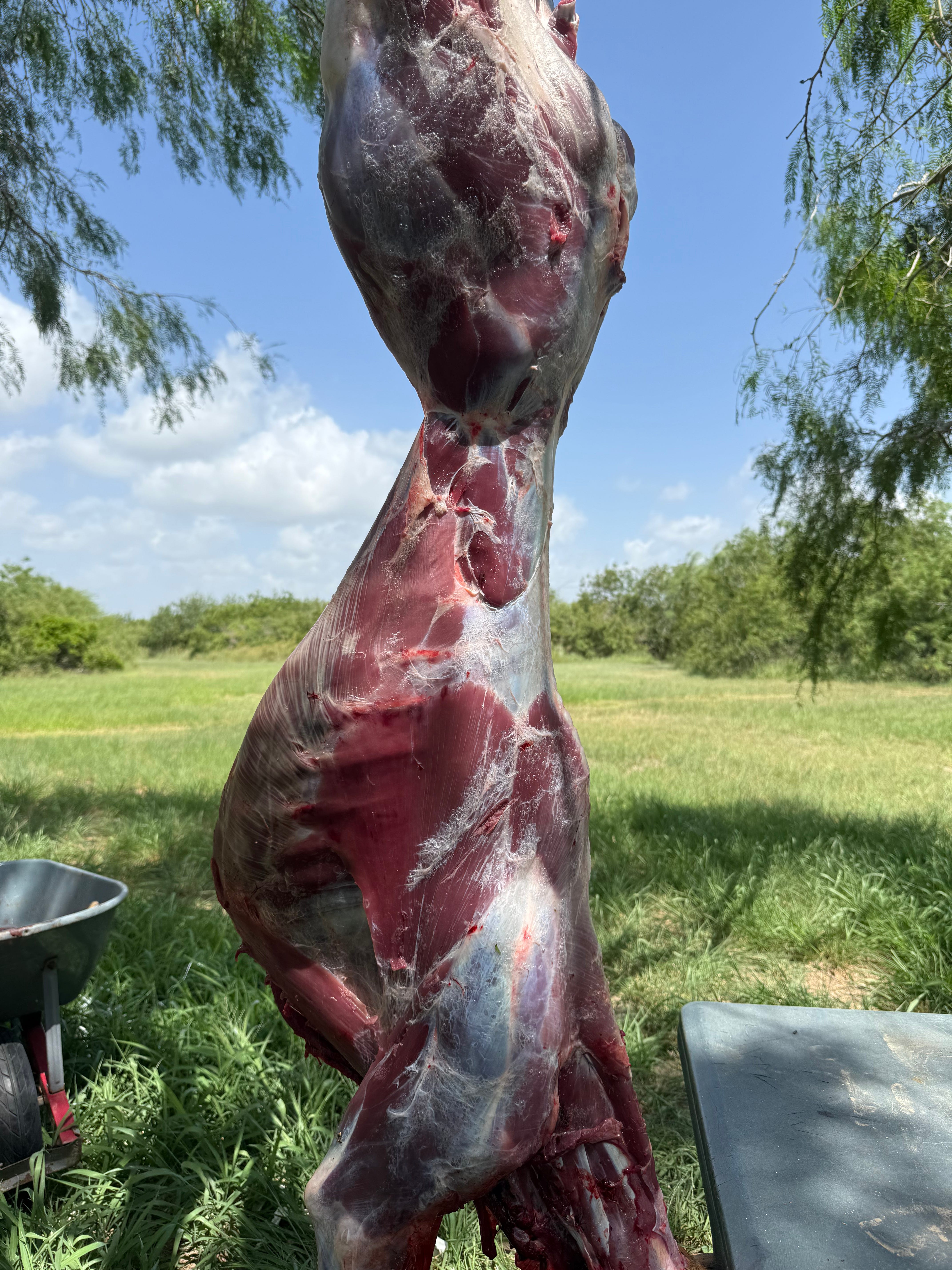
Dressed and ready for splitting. Photo by Ben Christensen
Closing the deal on a nilgai—whatever size or sex, really—is a big deal. They provide plenty of delicious protein, and they’re more wary than any white-tail you ever saw. Some of y’all don’t get the chance to go out with a rifle after your quarry in the South Texas brush, but if you’d like to test yourself against these animals in that brushy patch of the Gulf coast, I do offer limited nilgai hunts every year. So that they’re an exclusive experience, they’re capped at six bulls and eight cows annually. If you are interested in booking, just reply to this email and I’ll send you a rate sheet. I can accommodate two hunters at a time with sufficient notice, and it is always fully guided. We offer loaner rifles and scope sighting.
I offer day hunts and all-inclusive packages if you don’t want to worry about where you’ll stay and what you’re going to eat and drink while you’re down there. If you hunt nilgai with me (which some of you reading this already have done—successfully) you’re not getting a curated experience. You’re getting the actual thing—low-fence, fair-chase nilgai that you must earn, and as many limits of birds as there are hunters during the hot days of dove season in September.
I’ll see y’all out there! -Ben