

By Ben Christensen
The Old Republic Journal
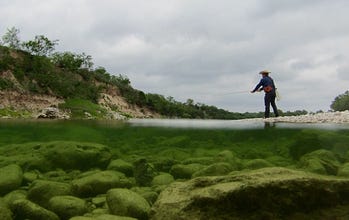
I just know that, at 120 CFS on the South Llano River at Junction and 262 CFS downstream on the main stem near Mason, the Llano is fishing very well right now, and that it has the conditions in its favor. The numbers don’t lie: with a CFS gain downstream where no rain has fallen, we can deduce the springs along the North Llano River, the tributaries, and the main stem are all discharging. The springs on the Llano are relentless in a way most other rivers on the Edwards Plateau can’t match. Also, the Llano’s streambed composition—gravel riffles and granite boulders being more prevalent than limestone folds slicked with green algae—makes it easier to fish on a hot, mid-August day. Will verify conditions later this week. Please stay posted.
Another one that has me raring to go is the tantalizing flow of the Nueces. Over the past five years, I have fished the Nueces many times during this drought, including the hot, hot summer of 2023. Flows were miserable, but discernible. Now, the river is still moving at 321 CFS, a month after the July inundations over all these areas. The Nueces really benefited as a watershed!
It’s been a hectic week for me, but not, unfortunately, on the water. I was last on a river with a fly rod in hand on my home waters, giving a “learn fly fishing” introductory class to a delightful couple (both fast learners) on the Pedernales River this past Saturday. The water was warm, with no detectable swooshes of cold spring water that usually accompany warm Hill Country river water, and there was a veneer of slippery algae on the rocks. Flows as of 6 p.m. last night on the Pedernales were down to 25.4 CFS. This is not the preferred 125 CFS, but it’s August, and winery venues are thirsty for water use.
Unfortunately for the Pedernales, the big wine venues along U.S. 290 with operations adjacent to the river have a bad (and technically legal) habit of sinking shallow wells near the banks to draw out river water, contributing to reduced flows. And the fertigation introduces phosphorus and nitrogen that pump the algae up. It’s not the apocalypse—yet—for the Pedernales, but the river is on the decline due to Fredericksburg’s ever-increasing popularity. San Antonio was once a town that increased in popularity until its artesian springs were pumped dry 100 years ago… Now the San Antonio River is effluent discharge from wastewater plants. Yay.
Some things to bear in mind as you wonder whether you should get out there with a fly rod: triple-digit heat takes a toll. I have fished with a hydration system on my back all these years, and I recommend them. A one-gallon stainless steel jug of ice water, a 64-ounce hydration pack, and an ice chest full of cold cans of sparkling water or still water will go a long way toward preventing heat exhaustion or worse. And the fish? Bass thrive in hot water. Guadalupe bass, specifically, seem to thrive all year—the largest fish out here that’s liable to take your fly in late November through late February. But in the summer, everyone is on: Rio Grande cichlids, carp tailing in warm, scummy eddy pools along clay banks, and largemouth bass at their best. Go early or late. Many of these rivers are a serious drive, even for someone like me already living in the middle of it. Consider camping—weekdays are empty now that school’s back in session.
Fall bassin’ is right around the corner—hang in there. If you can catch the baitfish migration along the lower to mid-Gulf Coast, I strongly recommend it. That will be on until at least mid-October.
We’ll see y’all out there. —Ben
Nice post.
Its hot as hell in DFW...(and to be honest much of the country.)
But, I will take it over the cold.