

By Ben Christensen
The Old Republic Journal
Editor’s Note: Fly fishing is cool. I think we need more artful and conscientious people with fly rods on our Old Republic waters. Therefore, I am developing a section in The Old Republic Journal that is a repository of what I hope will be useful information for beginners, not just advanced or intermediate-and-improving fly anglers. This is the first installment, going from general to more specific.
I should have picked up a fly rod thirty-one years ago. I remember the inner dialogue I was having with my nineteen-year-old self as I looked at a saltwater fly fishing magazine on the magazine rack at the Marine Corps Exchange at the School of Infantry on Camp Pendleton, California. Sure looks cool, I thought. Seems like that’s the way I fish with a spinning rod anyway. Find a red on the flats and go catch him. Spot and stalk. It might be more fun with a fly rod.
I went so far as to buy the magazine. Fly fishing seemed so Zen, with all that beautiful fly line in the air. I imagined aiming casts with precision and presenting flies to the nose of a fish and then playing it, palm on the reel for drag. Then that timid, negative, Charlie Brown self-talk took over. Nah, I thought. It’s too windy all the time. Fly fishing looks too technical. I’d never catch anything. The gear is too expensive.
I regret spending 20 more years with a spinning rod when I could have been fly fishing. A lifelong angler, I graduated from Port Isabel High School, home of the Fighting Tarpons, across Highway 100 on the lowerlower Laguna Madre. I grew up on the Laguna Madre, fishing world-class destinations like Three Islands and South Bay. As a spot-and-stalk, redfish-on-the-flats, and jetty-tarpon guy, I was a fly fisher with the wrong gear in my hands.
It turns out my doubts about fly fishing were mostly wrong. Fly fishing is more fun than spin-fishing or throwing a bait-caster. It’s more suited to the kind of fishing I love, which entails finding fish first and then catching them, an enthralling and ever-challenging form of hunting. The way the spin-fish market has gone—growing ever snazzier and more expensive—and knowing the fly fishing market the way I do now, I can confidently say that fly fishing’s price point isn’t far enough out of reach to be the reason someone doesn’t pick up the sport.
Fly Line, Rod, and Reel Weights—The Old ‘Dubya Tee’
Before you buy a rod, let me offer a quick explainer about how we choose, because fly rod and line descriptions are technical and jargon-forward: fly rods and fly lines run typically from 2 WT to 12 WT and the ‘WT’ is read weight. The weight of a fly rod refers to an index scale of the weight of fly line in grains the rod is suited for. The fly line of a 4 WT rod should be 4 WT fly line: it is called “4 WT” because the first 30 feet of the fly line weighs 140 grains. One pound is equivalent to 7,000 grains (one grain is equal to 0.002285 ounces). A grain is an archaic but still-useful unit of measurement used not only in grading fly lines, but in reloading ammunition and archery. Some of you hunters have undoubtedly heard of a 120-grain bullet. Yep, that’s it. So an 8 WT fly line is 210 grains, and if you want the whole chart, google ‘AFFTA Fly Line Weight Chart’ or click here. And that’s how fly rods and fly lines are graded.
Now, back to your entry level fly kit: an Orvis Encounter 5 WT rod and reel combo, loaded with fly line, with case included is an emblematic entry-level fly rod, priced at $249 on Orvis’s website. Buying components separately gets more expensive, but if you have a seasoned fly angler help, the help to a beginner’s cast may be worth the extra expense and time.
Another question I get: “Do I need a fly fishing license?” Any person in Texas aged 17 and older needs a fishing license. Because I hunt and fish, I buy a Texas “Super Combo” every year, which bundles various fees for saltwater fishing, freshwater fishing, upland bird hunting, migratory bird hunting, big game hunting, etc. into one low-price of $68, which saves the resident Texan sporting enthusiast up to $18 if well-utilized throughout the year. Otherwise, a resident fishing license is $30 for freshwater, $35 for saltwater, or $40 for all-water.
To Tie, or not to Tie?
Being able to tie a fishing lure—a “fly” in fly fishing lingo—and trick a fish is for many fly anglers one of the sport’s most alluring aspects, and one not readily shared with conventional fishing. The importance of this attribute of fly fishing struck me one morning on a back bay near Galveston, as I watched a mean bully of a redfish attack the “redfish crack” fly I had tied only the night before with my buddy Tim, specifically for our trip. I thought about how effortless it had been to tie the redfish crack and how satisfying it was to start with a shiny, bare hook, wrap some thread around the shank, add some fuzz to it, wrap more thread around the rest of it, draw some little stripes on it with a Sharpie at the end, and voilà: I’m catching big fish. This was so much better than taking a baggie of rubber Cocahoe minnows that won’t break down in the environment for another eight hundred years.
Discovering Warm Water Fly Fishing, and When It’s Not Appropriate
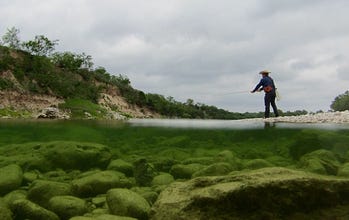
It is almost a ritual among beginning fly anglers in Texas that they were either drawn to it for the Guadalupe River stocked trout tailwater below Canyon Dam, or they are herded in that direction by whomever is advising them.
My son and I were the same when we started fly fishing up in the Hill Country. The friendly and helpful fly fishing evangelist who got my son into it also took him straight to Sattler for his first experience. He caught a beautiful rainbow trout and got a lovely picture. When my son evangelized me very shortly thereafter, I accompanied him to Sattler, ponied up my $10 per person, and we waded the Guadalupe below the dam and caught rainbow trout. That’s what fly fishing is all about, right? Rainbow trout?
Unfortunately, I can’t even remember what brought us out into the bright light of the truth that warm water fly fishing—for Guadalupe and largemouth bass, Rio Grande cichlids, a variety of panfishes, and catfish and carp—is amazing, and more varied and captivating, perhaps, even than nymphing for rainbow trout. But I am not a warm water snob, and no fly angler I know is. We all love to sneak down to Sattler in the winter on a weekday and catch trout there. Even more, we love road tripping into the Mountain West, car or backcountry camping or both, and fishing for big brown trout, lovely rainbows, deleterious brookies that we cook with butter and eat, and my prize quarry—any native cutthroat I can bring to a dry fly.
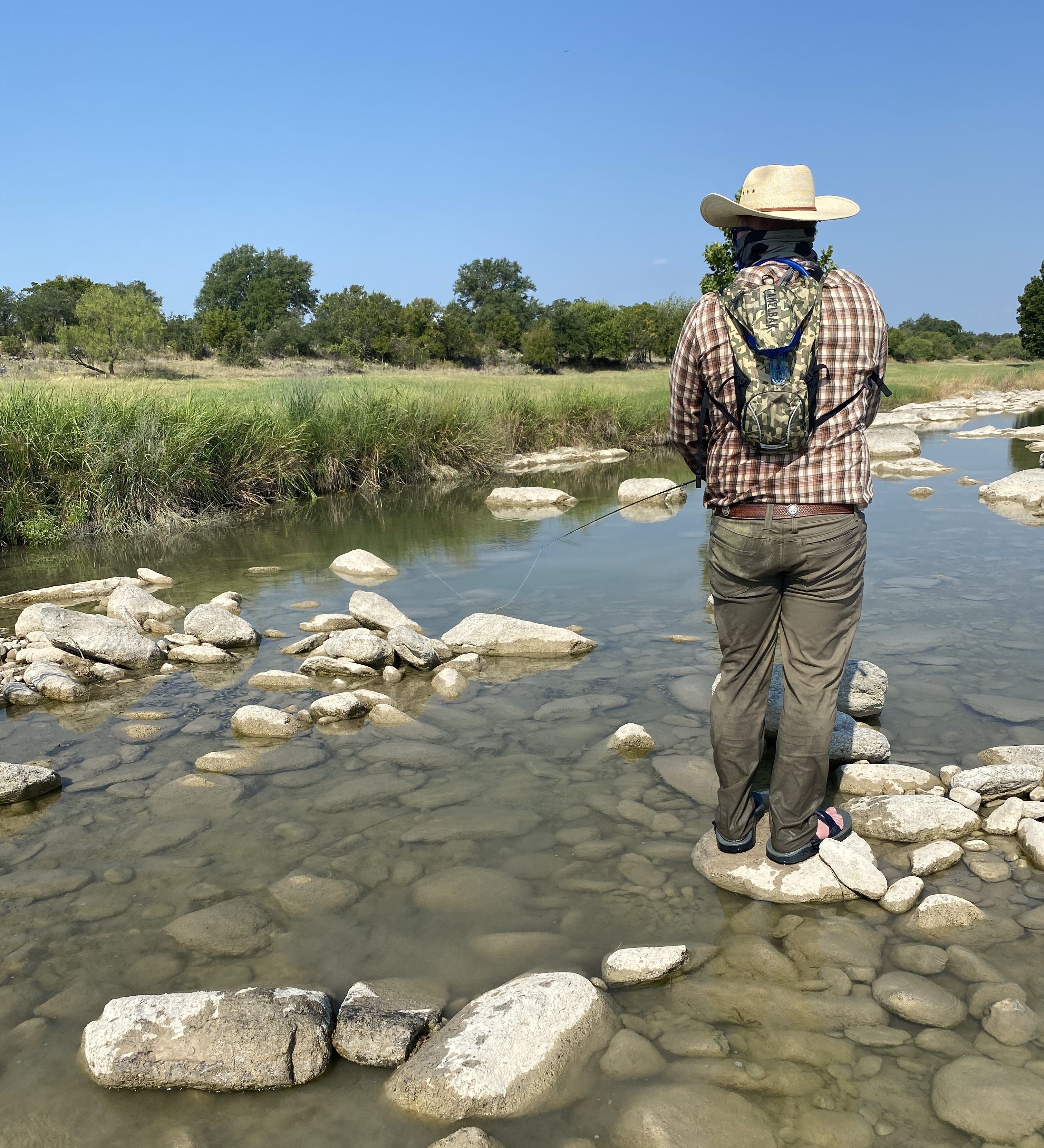
Also, this hot summer gives warm water fly anglers a reason to celebrate besides sheer “cool factor,” but it has to do with the concept of cool: summers of leaving trout alone when the water temperature climbs. We lament our Hill Country drouth, but most of our Mountain West fisheries, including within the boundaries of our Compromise of 1850 former Texan territories, have seen below-average snowpack and very little rain accompanied by above-average temperatures across the board.
People are rightfully worried about stream temperatures in New Mexico, Colorado, Wyoming, Utah, Idaho, Montana, and Arizona, as they have reached well into the 70s in most easily accessed trout waters. But trout are heat stressed in water temperatures above 68 degrees. That’s the surefire number. Currently, in Yellowstone National Park, so-called “hoot owl” fishing restrictions on those streams—no fishing from 2 p.m. to sunrise—were in place from July until this past August 13. The Firehole, and Madison within Yellowstone are still closed because the geothermal heat means they’re still too hot to fish, and the Gibbon River is only open upstream of Norris Campground. Colorado placed voluntary restrictions on fishing on 19 rivers this summer, something state officials called “unprecedented.”
Leaders in the fly fishing community out west have been regularly urging fly anglers venturing into the Mountain West to carry a stream thermometer in their kit, and they’re right. In places we Texans love to go during the summer, like the excellent Rio Grande headwater fisheries in southern Colorado, it just gets too warm in late July and August to fish for trout at “normal elevations.” The water warms up and the trout get heat stressed. Getting hooked is a death sentence for a trout in those conditions.
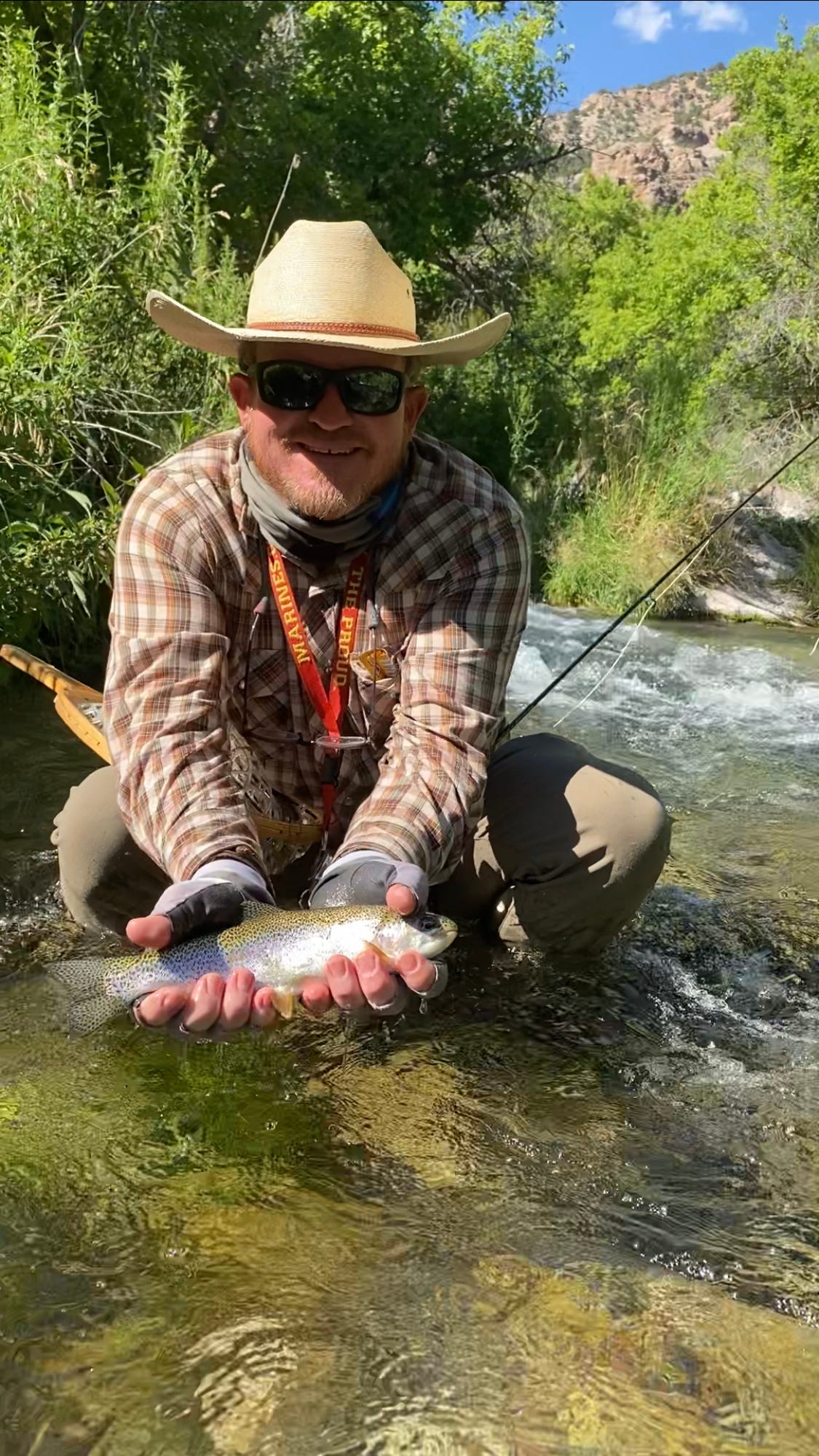
So, unless you’re meat-hogging 12-inch rainbows and 10-inch native cutthroats, fishing in the heat of summer is considered poor form, except at the high-elevation alpine lakes. (Not so for non-salmonid species like bass, though!) If you get up to 10,000+ feet above sea level, chances are the trout-bearing waters are as cool as they need to be up there. If you’ve camped in the backcountry in Colorado in August you know about the late-summer monsoon, where it rains all night up in the mountains but not down in town.
I do hope I find one of you dear readers out there one day—anywhere from the Llano to the Arkansas. I’ll be the fly angler wearing a lucky buff that doubles as sun protection. The buff, patterned after a largemouth bass, was designed by my friend Nate Karnes of Remedy Provisions. I’ll be fly fishing with an old Resistol George Strait straw cowboy hat on, probably waist-deep in water.
We’ll see y’all out there. -Ben