
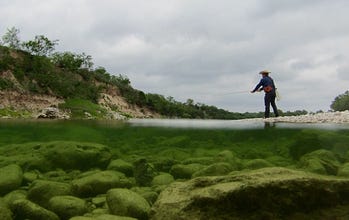
Fishing in the Middle of Damn Summer
Success on the fly when the temperature is high...

By Ben Christensen, Old Republic Journal
In the summer, and especially at full moon or bright moon, fish feed when it’s cool, overnight and around dawn, retreating to deep pockets under shady banks before mid-day. Rio Grande Cichlids—the only native tropical cichlid in the United States, only found in Texas—will find well-shaded underwater caves and structure in the faster water, often sharing it with the State Fish of Texas, the Guadalupe Bass—“Texas Trout.” Like trout, Guads love faster, aerated water, average in the 12-inch range, and are favored for the way they take flies with slashing and aggressive attacks, frequently jumping during the fight the way trout will.
Largemouth are going to be in their holes, under their shade branches along the banks. And carp will be cruising sandy-bottomed flats mid-river and in reedy flats, but feeding activity is more pronounced when it’s not midday.
To test this theory, I pulled up to the low-water crossing on the Pedernales just before noon this past Tuesday, a section that was still receding following the flooding that occurred 10 days previous. I was out to prove to myself that I could catch fish on a hot mid-summer day, with temperatures pushing into the mid-90s and the sun a-blazing near its zenith in a clear blue sky.
I put the electronic key fob in the console and detached the spindly analog entry key, zipping it into the hip pocket of my wading pants. I threw on the old, weather-worn George Strait Resistol palm leaf cowboy hat and a largemouth bass-patterned neck gaiter. My sun gloves rounded out the necessary sun protection.
I dropped the tailgate of the pickup and hopped up with my wading boots and neoprene gravel guard stockings, two pieces of gear that have transformed the experience of wading rocky streams. If you don’t already have them, and if you wade streams more than once per year, seriously consider buying a pair of wading boots and gravel guards. I consider them essential gear because of the protection they offer to feet, and the sure grip that prevents painful wipe-outs and banging a shin on limestone.
As I slipped the boots on, I looked up into the pecan tree I had parked next to, pausing to admire cedar fence posts plastered to it above my head. I admired the 100 yards or so of wiped out fence along the riverbank before tying the boots and folding the neoprene over the top of them. I hopped down and got my rod case out, carefully removing a Scott Radian 5/6, lining up the ferrules and snugging the four pieces into one lovely length of rod. I pulled the old TFO 4/5 reel out and seated it on the rod, coaxing the tapered co-polymer leader from the spool until I was into the fly line proper. Doubling the fly line over, I threaded it through the ferrules one at a time, careful not to skip one. With the line and leader threaded through, I laid the rod and reel down in the bed of the pickup and got my starter fly out.
I was badly in need of tying up a new batch of flies, but, pressed for time, I grabbed a variant of my go-to pattern invented by my son Daniel: the “Chips ‘n Salsa.” Without exaggeration, it’s a favorite eat for every fish in the Texas Hill Country. I have never, ever fished with a better fly, in any water.
The last time I tied up flies, I got lazy and omitted the black Palmered hackle near the bead-chain eyes, so it wasn’t a true Chips ‘n Salsa, but a hastily tied guide-fly version. I tied it on, locked the truck, stuck the fly box in my right breast pocket. A bit worried about leaving my hemostat behind, I crossed the farm-to-market road and stepped into a shin-deep river flowing at approximately 140 CFS. It was warmer than I expected.
Mid-summer hits sometime about the third week of July. Technically, the 2026 Hill Country flooding was tapering off right at the mid-summer peak, which couldn’t have been a better setup for fly fishing enthusiasts of the region. God-willing, we are seeing the El Nino shift starting.
I looked downriver past the bridge and saw a 50-yard section of sycamores, pecans, and cypress trees plastered down flat and brown, exposing a section of flood plain river bed I never knew existed. It resembled a scoured, brown wasteland—a reminder of the power of these streams. Upriver, there were downed trees, but not very much human flood debris, a notable exception being a rather large, white hot tub sitting high on the bank river left. The river-adjacent landowners had not yet started trying to rebuild their riverside fences, and this flood took out robust and lengthy sections of river. I will remind everyone here yet again: the river does not give a damn about anyone’s fences.
When stalking upstream from an access, looking for suspended bass that show like electric pickles in gin-clear water, it’s nice to have the sun above to your back—even a high sun. That way, if fish are looking your direction, they have to look through a lot of glare before they can make out your lumbering form stalking their way. With the sun in your face, that dynamic is reversed, and fish that you still haven’t spotted will flee away, little torpedoes darting to some farther pool. To catch them, you must give them time to “reset.” If you see a nice fish you’d like to catch settle in the next pool upstream, and you know you can find it, you’re better off waiting 15 minutes, because fish tend to be very unlikely to take a fly directly after they’ve been spooked. Unless they’re sunfish or smaller Rios. Panfish are aggressive and always ready to give you a chance.
Change flies often if you want to catch more fish. I caught a small largemouth within a minute of starting my Tuesday wade, so I “got the skunk off,” which means I am free to go as hard or as easy as I want.
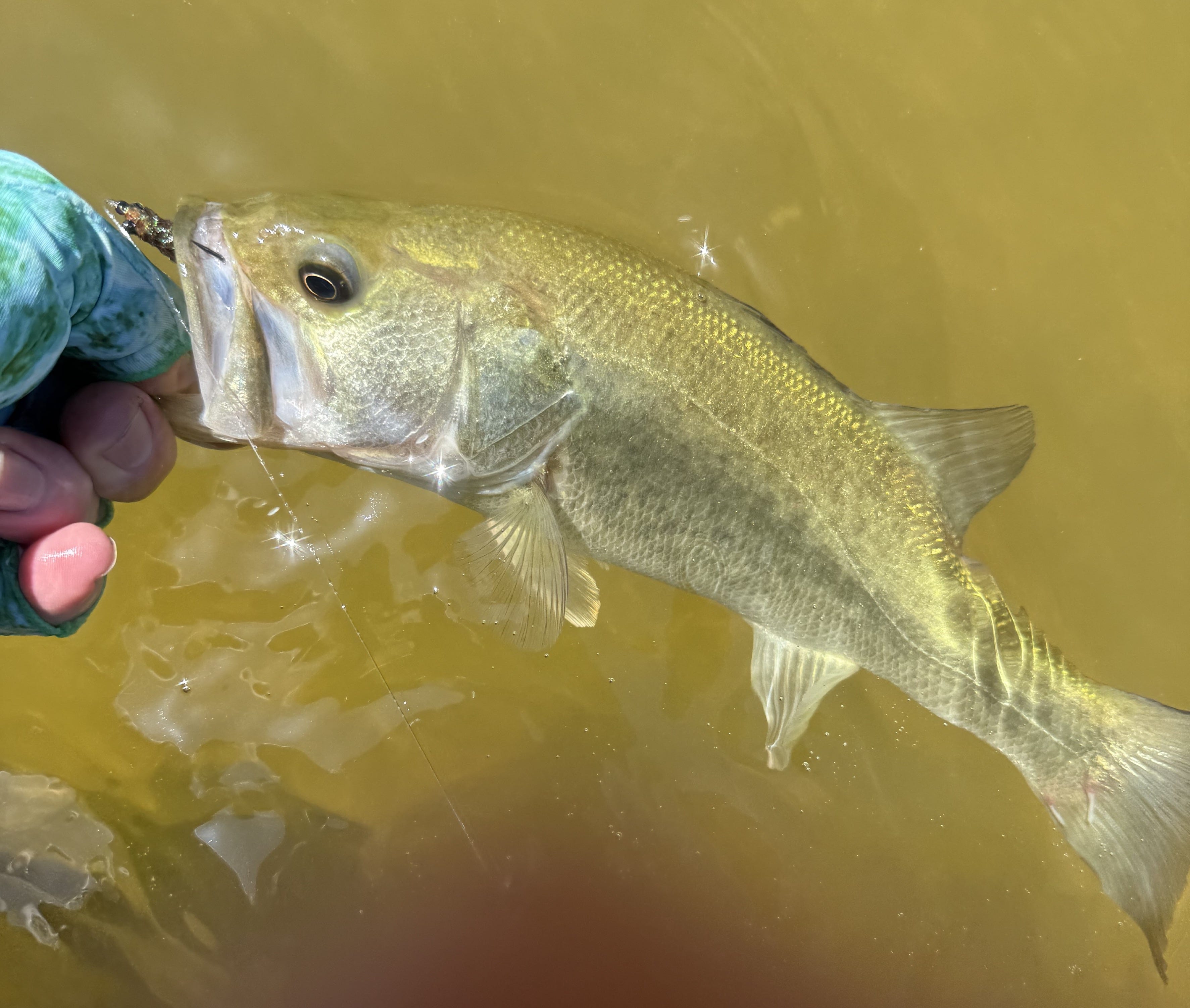
The “skunk-off” bass in the first five minutes. Photo by Ben Christensen
I personally enjoy getting lost in my fly casting, presenting to every point of the clock ahead of me, with 12 o’clock being straight upstream—and even a few downstream from around 7 and 5 o’clock—before moving on. When I am honed in on my casts, I almost never change flies, and it can take me a half-hour or more to get bored with the meditative practice of walking upstream, fly casting as I go. Even though I’ve fly fished avidly for nearly a decade and a half and my casting is decent, as I walk and cast, I notice my casts get better: less hurried, unforced, and far more accurate.
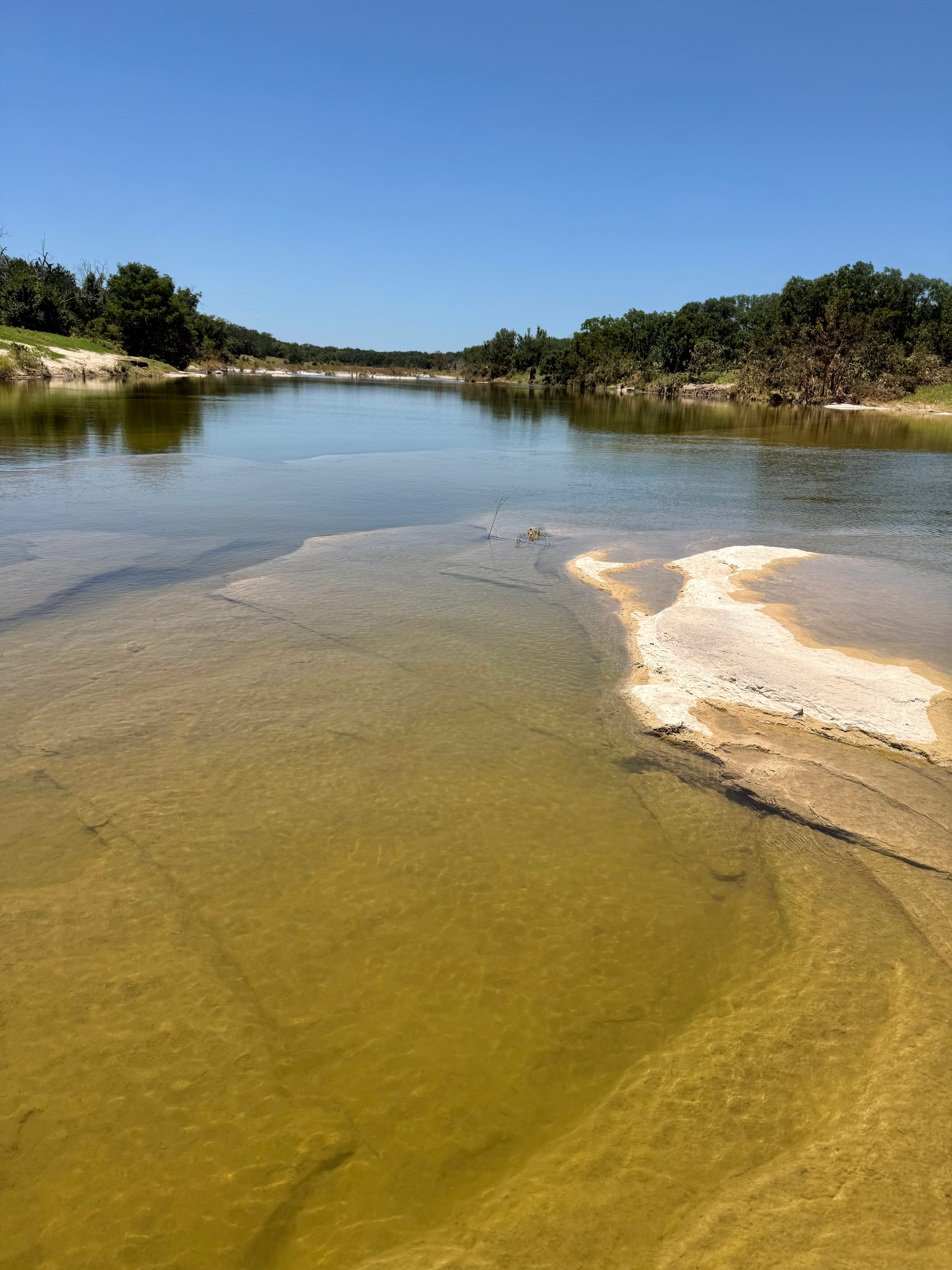
The Pedernales on Tuesday. Photo by Ben Christensen.
I had gotten a quarter-mile upriver from the low water crossing and had just high-sticked a tiny sunfish out of a cave when I finally got bored enough to tie on a big popper (the Rios I was after had spotted me and retreated deep into the cave, not having any of it). I grabbed a black, plastic-headed popper (one day I will learn to spin deer hair, I promise) and tied it on, having found a likely looking shaded hole.
With my well-honed cast, I gently placed the popper on a bare patch of bank about two inches from the river, and popped it onto the surface water. After two pops, I got a fantastic blow up—and a miss. My heart jumped and my pulse was off to the races, pumping away as the twinge of adrenaline started to disperse through my veins.
I caught two smallish largemouth bass in the 10-inch range like this, but they gave me vigorous fights with jumping as I prefer. My concerns about not having my hemostat were unfounded, as the head of the popper made extracting the hook from perfect lip-hooked sets very easy. I took some pictures for this publication and realized that it was getting hot.
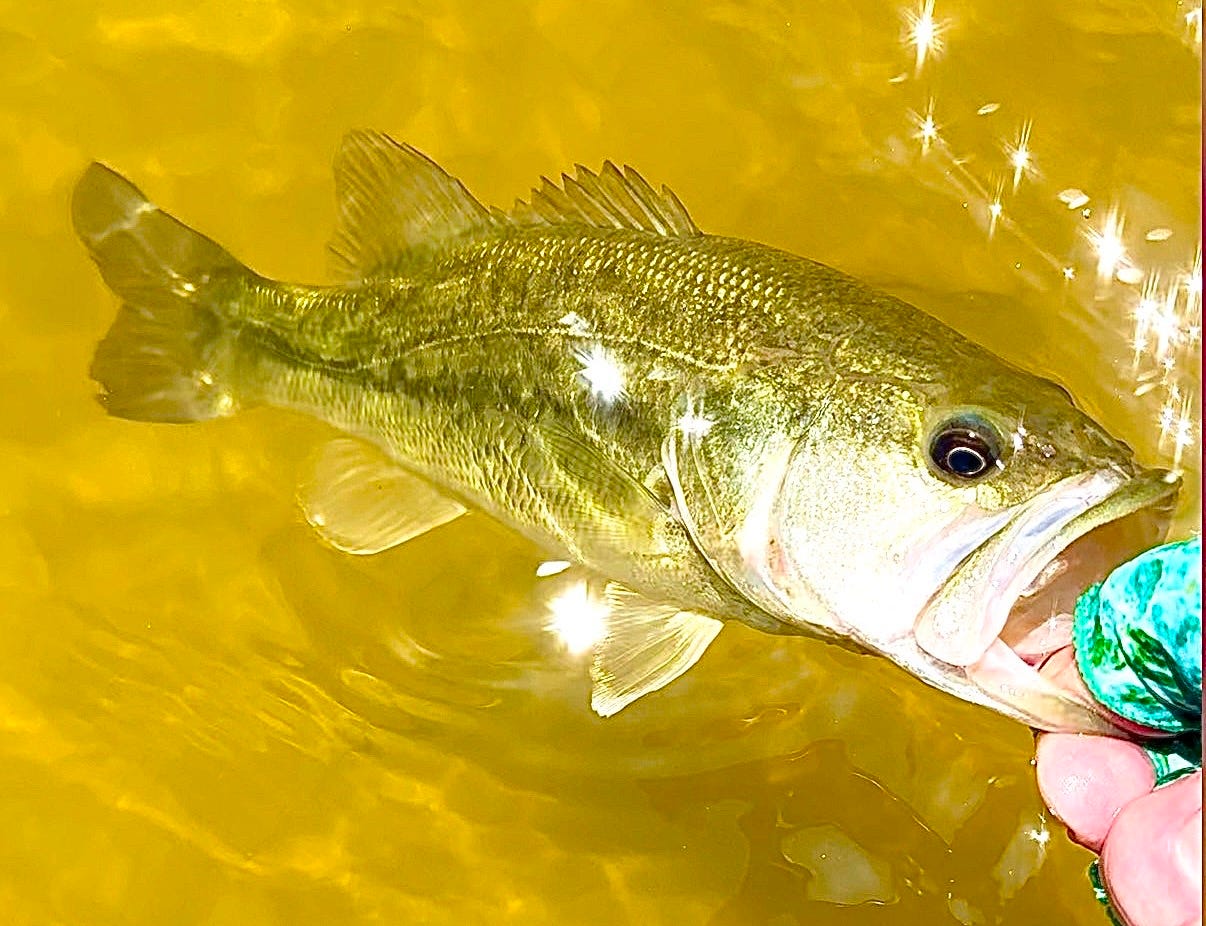
Largemouth on the popper. Photo by Ben Christensen
Summer is a good time to test the water, and experience firsthand where the fish are. A hung fly on some limbs overhanging a shady hole provides an excuse to wade into the middle of it, scanning for toad largies hastily leaving the area. Wading into a hole to dislodge a fly as well as our quarry is sometimes unavoidable. It spoils the fishing in the hole for at least a half hour, but the silver lining is, it gives the fly angler necessary firsthand experience about fish and their cover.
Finally, even though we celebrate stream flows in the hundreds at mid-summer, when they are usually stuck at two or three CFS, there are spots all over this region that fish consistently and well, even in the lowest water. While many, I admit, devolve into a morass of algae and dead water unsuitable for fly casting, some ripple along over limestone and fish still charge out from holes to take a fly, or slam a popper on the surface.
Don’t let this heat stop you. Get out early if you can, try poppers and hoppers along the banks, and get after it! It’ll be fall bassin’ before we know it. I will leave you with some stream flow numbers on some of my favorite Hill Country Rivers
Current Hill Country Stream Flows (as of 6:00 PM yesterday):
Pedernales River (near Johnson City): 103 CFS
Pedernales River (near Fredericksburg): 120 CFS
Llano River (near Mason): 551 CFS
South Llano River (at Flat Rock Lane at Junction): 178 CFS
Guadalupe River (near Bergheim): 438 CFS
Nueces River (at Laguna): 761 CFS
We’ll see y’all out there! -Ben